Different Time Regimes in Coronavirus Binding and Infectivity Mean that Time is of the Essence
Ikechukwu Iloh Udema
*

Department of Chemistry and Biochemistry, Research Division, Ude International Concepts LTD (862217), B. B. Agbor, Delta State, Nigeria.
*Author to whom correspondence should be addressed.
Abstract
Researchers have focused on time-dependent infectivity, exploring specimens from patients in hospitals and cell lines in in vitro studies; less attention is given to time regimes before infection and early viral load peaks. The theoretical study aims to address the period of time before the viral load peak, with objectives that include determining the total duration from exposure to symptom onset and potentially to the viral load peak, as well as evaluating for the first time an equation that considers breath emission rates and viral number density in both open and confined spaces. Calculations were carried out based on derived equations fitted to the data in the literature. The time interval between infection and peak viral load (experimentally known) ranged between 3.88 and 28.48 days, and with the theoretically determined peak viral load, it was between 6.02 and 21.20 days for SARS-CoV, SARS-CoV-2, and MERS-CoV. The order of virulence based on the timing of events is SARS-CoV-2 > SARS-CoV > MERS-CoV; the time interval between infection and the earliest peak viral load are 0.103 and 1.09 days for SHIV-KS661 viral RNA in Nef-positive and Nef-negative HSC-F cells, respectively, with Nef-positive cells being more susceptible. Given viral number densities of 1.29 e. (+7) and 27.9 e. (+7) particles/m³, the calculated time to infection was 9.04-9.17 and 8.27-8.4 days for the Delta and Omicron variants, respectively, indicating the latter's higher virulence. The results, given breath emission rates of 9.31 and 201 e. (+6) per hr. of the Omicron variant, were 6.39 and 7.11 days, respectively. In conclusion, there are different time regimes for different events leading to symptom onset and viral load peak; there should be a threshold for infection as demonstrated with the lower time regime, where either viral number density or BER is higher. Some cells may be more susceptible than others. Future study needs to readdress the question of respiratory impact on the rate of infection in infested environments.
Graphical Abstract
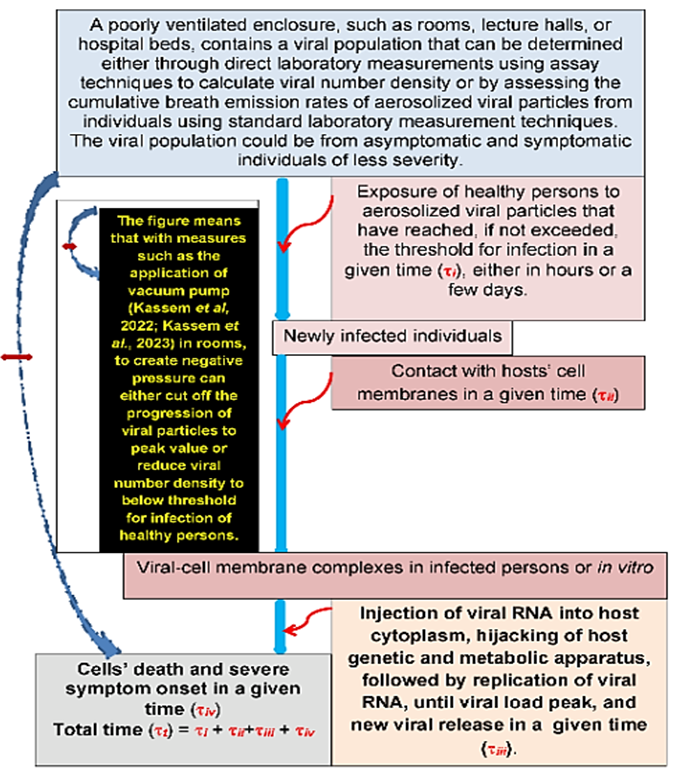
Keywords: Coronaviruses, time regimes, breathing rate, breath emission rate, viral number density, symptom onset