In A Pathophysiologic State due to SARS-CoV-2, Viscosity and Cholesterol are Double-edged Swords
Ikechukwu Iloh Udema
*

Department of Chemistry and Biochemistry, Research Division, Ude International Concepts Ltd., 862217, B. B. Agbor, Delta State, Nigeria.
*Author to whom correspondence should be addressed.
Abstract
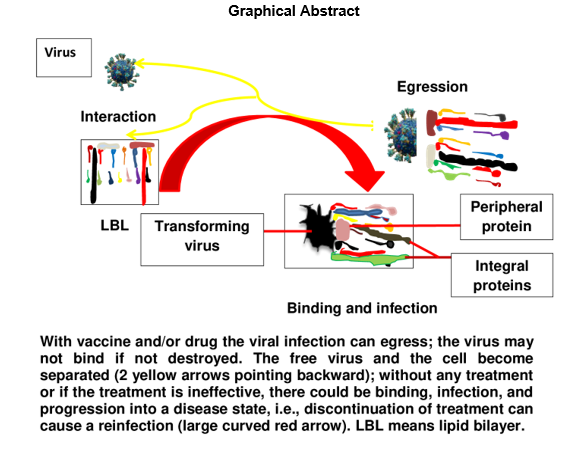
Much attention has been paid to the genetic composition and molecular biology of viral particles, infection, and micro-anatomical impacts that culminate in fatalities; vaccines have been in continuous development and production; less attention is paid to the fundamental issues of thermodynamics and activation energy characterization of viral binding to cell membranes. The study aimed at deriving equations that can be fitted to both theoretically and empirically derived data for the quantitation of other thermodynamic parameters and its cognate dimensionless equilibrium constant; some of the derived equations addressed the issue of viscosity and the concentration of cholesterol in particular as they affect translational velocity needed for the delivery of biomolecules to the site of need. The instantaneous velocities before terminal velocity are: ~ 0.046674 m/s (cytosol); 0.141837 m/s (water). The terminal velocities were approximately equal to 3.548614 for the cytosol and 99.590626 nm/s, for water; these values were computed using literature values of translational diffusion coefficients (Di) of glucose in cytoplasm and in water. The value in water is higher than in the cytosol because of higher cytosolic viscosity than aqueous viscosity. Higher viscosities in the membrane and in the cytoplasm enhance binding and infection and can diminish the progress of infection, respectively. Higher feasibility and rates were observed at lower thermodynamic temperatures than at higher ones. It is advised, among others, that pharmaceuticals (including airborne surfactants) and drugs in solution be given at temperatures above body temperature. Future in vitro and in vivo studies on viral infection might focus on various time periods at different temperatures, above and below body temperature.
Keywords: Coronaviruses, spike protein, lipid rafts, cholesterol, viscosity, dimensionless equilibrium constant